Hall of Fame Fr. Joseph Horan
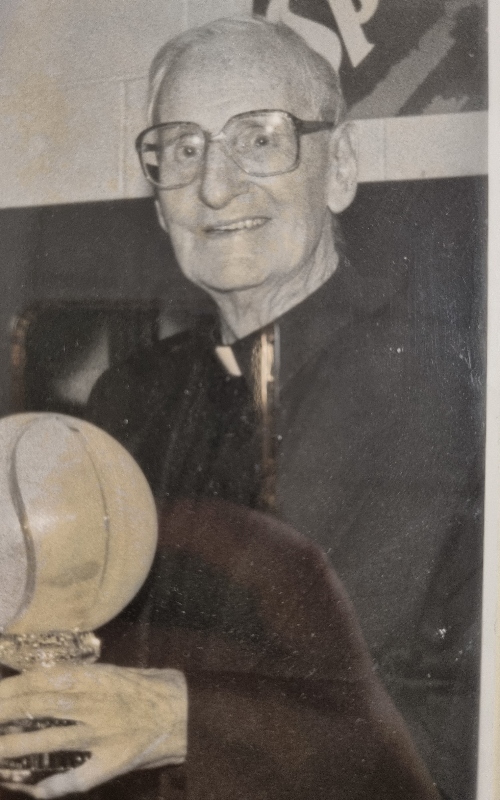
Fr. Joseph Horan
Fr. Joseph Horan founded the "modern" National League
- Hall of Fame induction
- 1998
- Club associated with
- Naomh Mhuire Club
Fr. Joe was originally from a strong hurling background in Co. Offaly. He first came into contact with basketball when stationed in Italy in the early 40’s. He recounts many stories of playing basketball in the open air with play having to be stopped for the players to run to bunkers during the Allied air raids.
On his return to Ireland Fr. Horan co-founded the UCD Club with Harry Boland and a year later set up the Leinster Schools and Colleges Organisation. Four teams entered the U-19 and Eight teams entered the U16 league in the first year.
In the 50’s and 60’s the concept of Blitzs was first introduced to Irish Basketball by Fr. Horan. These were popular at the time in Italy and involved numerous teams coming to one central venue to play against each other over a short period of time, a concept that is still popular today. Fr. Horan referred to blitzes as “basketball in a hurry”
To most people today, Fr. Horan will always be associated with the Naomh Mhuire Club and with the Oblate Hall, Inchicore. The Naomh Mhuire Club dates back to 1964 when Fr. Horan founded it as a Rounders and Athletics Club to provide a sporting outlet for the young girls in the Inchicore area of Dublin. In 1971 the Naomh Mhuire Sports Hall was opened (cost £35,000). This became the “home” of Irish Basketball in the ‘70’s and ‘80’s.
Forever the “international”, Fr. Horan always kept an eye on Europe and the broader development of Basketball. There was no way Irish Basketball was going to be left behind its European neighbours! In the 1980’s he pioneered Naomh Mhuire’s entry Into the Lilliana Ronchetti European Cup on two Occasions.
But even earlier, in the 1960’s, he advised the famous Dublin Celtics, Belfast Celtics and Collegians on their entry into European Cup competitions. He always had his eye on the bigger picture. Indeed, his multi-lingual skills were very useful as he acted as interpreter.
An ability to see the broader picture, was one key ability that made Fr. Horan stand out. This was certainly so when he pioneered the establishment of the “modern” National League in 1972. He was breaking new ground with this move, and it was not always an easy path to take. Some of the more traditional groupings in Basketball were opposed to the move, but as we can now witness, 54 years later, Fr. Horan’s vision became a great success.
Everyone involved with basketball today is someway in debt to Fr. Horan for his vision and dedication to the sport he loved.

FIND US
National Basketball Arena
Tymon Park, Dublin, Ireland
D24 N449 (map)
T: +353 1 459 0211
E: info@ireland.basketball